
How USDT via Lightning provides dollar liquidty at high speeds

Comet Cash Team
•
Dec 14, 2025

USDT on the Lightning Network combines the stability of a dollar-pegged stablecoin with the speed and low fees of Bitcoin's Lightning infrastructure. This setup enables instant, cost-effective cross-border payments and seamless currency switching, making it ideal for businesses, developers, and individuals handling frequent transactions.
Key Points:
USDT (Tether): A stablecoin tied to the US dollar, maintaining value close to $1.
Lightning Network: A layer-2 Bitcoin solution for fast, off-chain transactions.
Taproot Assets Protocol: Enables stablecoins like USDT to operate on Lightning.
Benefits:
Near-instant settlements (seconds).
Transaction fees are fractions of a cent.
Scalable for high-volume use.
Use Cases:
Businesses: Cross-border payments, retail transactions.
Developers: Payment app integration.
Individuals: Remittances, international purchases.
USDT on Lightning simplifies dollar liquidity, but businesses must address risks like regulatory compliance, liquidity management, and counterparty transparency to maximize its potential.
How Tether and Stablecoins Will Run on Bitcoin’s Lightning Network
How USDT Works on the Lightning Network
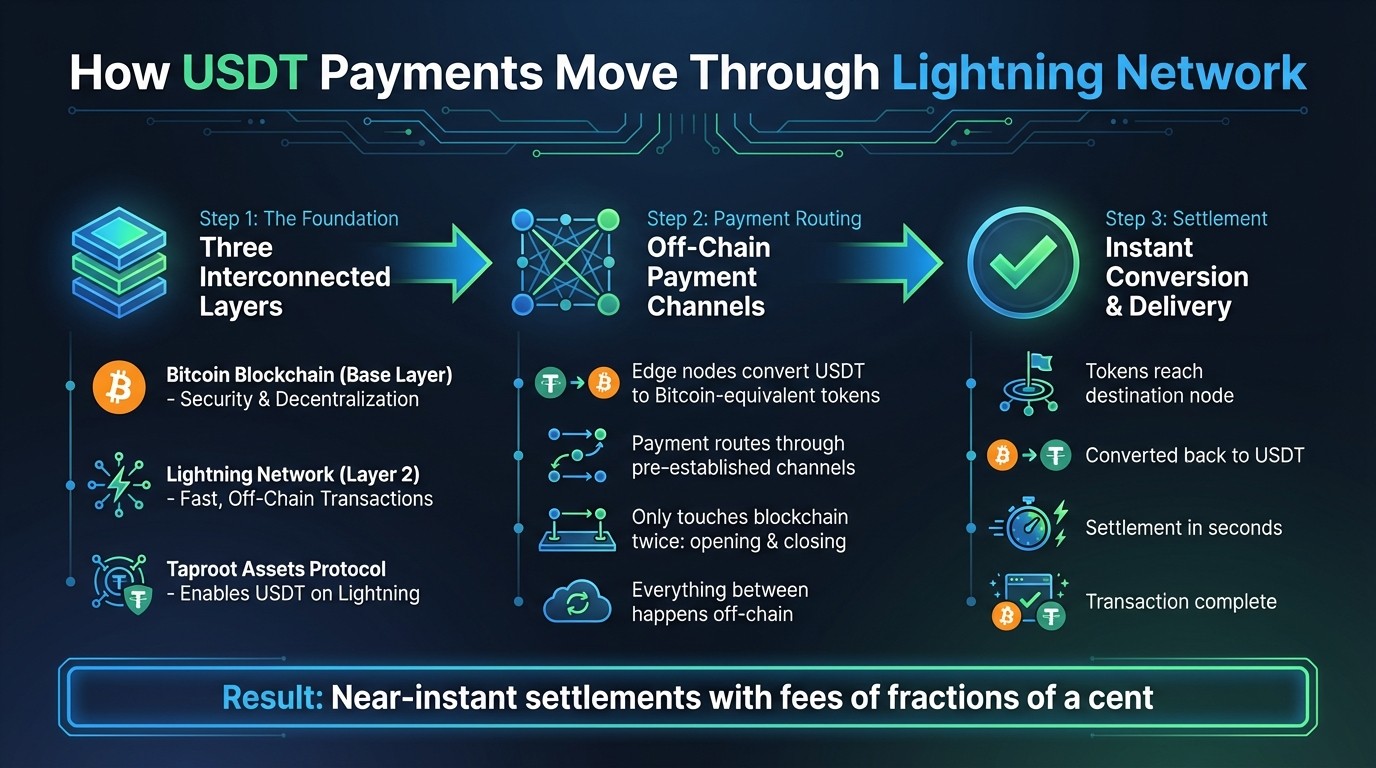
How USDT Payments Move Through Lightning Network in 3 Steps
Bitcoin, Lightning, and Taproot Assets Explained
USDT on the Lightning Network relies on three interconnected layers. At its core is Bitcoin's blockchain, known for its security and decentralized nature. The second layer is the Lightning Network, a layer-2 solution designed to handle fast, frequent transactions by shifting most activity off-chain. The third layer is the Taproot Assets protocol, created by Lightning Labs and built upon Bitcoin’s Taproot upgrade introduced in November 2021.
The Taproot Assets protocol allows stablecoins like USDT - and other digital assets - to be issued and transferred directly on the Lightning Network. It uses the same infrastructure that powers Bitcoin transactions, enabling quick and low-cost USDT payments. This setup supports the goal of delivering fast and efficient dollar-equivalent liquidity.
How a USDT Payment Moves Through Lightning
When you send USDT via the Lightning Network, the process happens almost instantly through pre-established payment channels. These channels function like open accounts that only interact with Bitcoin’s main blockchain twice: once when funding the channel and again when closing it. Everything in between occurs off-chain, ensuring quick and efficient transactions.
Here’s how it works: edge nodes convert USDT into Bitcoin-equivalent tokens for routing through the network. Once the payment reaches its destination, the tokens are converted back into USDT. This seamless flow is what makes USDT transactions on Lightning so swift and reliable.
Tools That Support USDT on Lightning
The integration of the Taproot Assets protocol, Lightning Network, and Bitcoin’s base layer forms the backbone of USDT functionality on Lightning. Businesses and payment gateways can easily adapt to support USDT with minimal adjustments, thanks to the existing Lightning infrastructure. Tools like Comet Cash provide APIs, SDKs, and user-friendly dashboards, making it straightforward to enable real-time, non-custodial USDT transactions. This means businesses can start accepting USDT without needing in-depth blockchain knowledge or significant technical overhauls.
Benefits of USDT via Lightning for Dollar Liquidity
Speed and Cost Efficiency
Using USDT on the Lightning Network allows transactions to settle in just seconds. Compare that to traditional banking systems, which can take anywhere from several minutes to a few days to complete a single transaction. This makes USDT on Lightning a perfect fit for high-frequency payments, cross-border remittances, and everyday transactions that require quick confirmations.
And the cost? Practically negligible. Transaction fees are just fractions of a cent. For businesses managing thousands of payments daily, this means predictable and minimal costs - something traditional systems often can't offer.
Stability and Scalability
Unlike cryptocurrencies such as Bitcoin, USDT maintains a stable value thanks to its dollar peg. This stability ensures that both individuals and businesses can transact without worrying about sudden price swings, making it a reliable option for transferring value.
The Lightning Network itself is built to handle massive demand, scaling to millions of transactions per second. This scalability keeps the network efficient and affordable, even as more users join. Plus, because transactions happen off-chain, users enjoy added privacy while still benefiting from Bitcoin's robust security features.
These features make USDT on Lightning a standout choice compared to traditional payment systems.
USDT on Lightning vs. Other Payment Methods
Payment Method | Time to Settle | Fee per Transaction | Technical Complexity | Cross-Border Capability |
|---|---|---|---|---|
USDT on Lightning | Seconds | Fractions of a cent | Moderate (API integration) | Yes |
On-Chain USDT (Ethereum, Tron) | 1–15 minutes | $1–$50+ | Moderate | Yes |
Traditional Banking (Wire Transfer) | 1–5 business days | $15–$50+ | Low | Yes |
ACH/SEPA | 1–3 business days | $0–$5 | Low | Limited |
USDT on Lightning breaks down many of the barriers that have traditionally limited stablecoin adoption. Its combination of instant transactions, ultra-low fees, and global accessibility makes it one of the most efficient ways to send and receive value digitally. Whether you're a business or an individual, all you need is a smartphone and an internet connection to start transacting almost instantly.
Building and Integrating USDT Over Lightning
USDT is known for its fast, low-cost transfers, but integrating it over the Lightning Network requires a specific technical setup.
Technical Requirements for Integration
To integrate USDT on Lightning, you’ll need a reliable and synchronized node infrastructure. Start by deploying a Lightning node, such as a litd node, which combines Lightning and Taproot functionality. Synchronize this node with the global Lightning network. The key technology here is the Taproot Assets protocol, developed by Lightning Labs. This protocol allows fungible assets like USDT to be issued on Bitcoin’s blockchain and transmitted over the Lightning Network as hashed metadata.
Elizabeth Stark, CEO of Lightning Labs, highlights this advantage: "Bringing USDT to Bitcoin combines the security and decentralization of Bitcoin with the speed and scalability of Lightning."
Next, establish and pre-fund taproot asset channels between nodes to enable instant transfers. A price oracle should be integrated to provide real-time USDT-to-Bitcoin conversion rates. Finally, upgrade your wallet software to support USDT on Lightning, making it easier for users to generate and settle Lightning invoices.
Using Comet Cash for Integration
For businesses looking to simplify the process, Comet Cash offers a ready-made solution for USDT integration on the Lightning Network. Their platform provides real-time Bitcoin and Lightning Network support through APIs, SDKs, and dashboards. Built with a non-custodial design, it ensures businesses maintain full control over their funds while benefiting from programmable payment flows. Comet Cash also includes features like team-based node management and customizable channel settings, enabling companies to adapt their Lightning infrastructure to their specific needs.
Implementation Examples for U.S. Businesses
In February 2025, Speed Wallet showcased how to scale USDT on Lightning. They deployed a network of litd nodes, synchronized multiple nodes to maintain a distributed ledger for USDT, and pre-funded liquidity across taproot asset channels. Speed Wallet also integrated a price oracle and updated their wallet software to handle USDT Lightning invoices.
U.S. businesses can adopt similar strategies for various applications. For example, point-of-sale systems can use USDT payments to settle transactions in seconds with minimal fees, making it ideal for high-volume retail environments. Treasury operations can benefit from instant cross-border transfers, bypassing the delays and costs associated with traditional banking. Payment processors can route transactions in Bitcoin while merchants receive USDT, reducing volatility risks while leveraging Lightning’s speed.
Some businesses have already shifted 30% to 60% of their Bitcoin transactions to Lightning channels, enjoying significant annual savings on transaction fees.
Risks and Compliance for USDT on Lightning
While USDT on Lightning delivers impressive speed and efficiency, businesses must carefully navigate associated risks and adapt to evolving regulations.
Trust and Counterparty Risks
USDT depends on Tether to maintain reserves that back each token. For years, concerns have lingered about the transparency and adequacy of these reserves. If Tether's backing turns out to be insufficient or poorly managed, USDT's value could become unstable. This centralized structure creates a single point of failure, unlike Bitcoin, which relies on its decentralized network for security. Businesses should closely follow Tether's reserve audits and weigh the risks of holding or transacting large amounts of USDT. These counterparty vulnerabilities are further intensified by increasingly strict U.S. regulations.
Regulatory Compliance in the U.S.
Regulatory scrutiny has significantly increased for stablecoins in the U.S. In July 2025, the GENIUS Act brought stablecoin transactions under the Bank Secrecy Act. This mandates stablecoin issuers to secure federal licenses, maintain segregated reserves, and implement robust AML and sanctions compliance programs. For businesses, this means enforcing stringent KYC/AML measures, keeping detailed transaction records, and ensuring visibility at the channel level. Furthermore, edge nodes facilitating USDT-to-Bitcoin conversions could face additional regulatory oversight and may need to meet specific licensing requirements. Partnering with regulated crypto payment processors can simplify compliance with these legal demands.
Liquidity and Routing Challenges
Operating on Lightning introduces unique risks that demand proactive management. To mitigate routing attacks and limit exposure, businesses should regularly update node software, cap channel balances, and maintain diverse, trusted routes. Another challenge is the "free call option" issue, where users exploit price movements during settlement, potentially causing financial losses for edge nodes. Pricing this risk into exchange rate quotes is a practical way to address it. As USDT transaction volumes increase, Lightning Service Providers and routing nodes will need significantly more liquidity to support smooth payment flows. Regular channel rebalancing and monitoring services can help detect and address suspicious activity before it disrupts operations. Sustaining fast and reliable USDT transactions on Lightning requires diligent monitoring and strong risk management practices.
Conclusion: High-Speed Dollar Liquidity with USDT on Lightning
The integration of USDT with the Lightning Network merges the reliability of dollar-backed stability with the unmatched speed of Bitcoin's Lightning infrastructure. This means businesses can now process payments in mere milliseconds, with transaction fees so minimal they’re measured in fractions of a cent. Compared to traditional banking systems, this approach offers a clear advantage in efficiency and cost-effectiveness.
Platforms like Comet Cash make it even easier for businesses to adopt this technology. By offering real-time, non-custodial USDT integration, they remove the need for complex in-house development. Through APIs, SDKs, and user-friendly management dashboards, companies - whether digital banks, fintech platforms, or payment processors - can seamlessly implement stablecoin payments. These tools handle the technical intricacies while maintaining a focus on security and adaptability.
At its core, this system relies on Bitcoin's fast, scalable payment infrastructure. While the speed and low costs are game-changing, businesses must still address key challenges like liquidity routing, counterparty risks, and maintaining payment channels. Successfully navigating these hurdles unlocks significant benefits: faster transactions, reduced costs, and 24/7 access to global dollar liquidity. As adoption grows and routing networks improve, USDT on Lightning is poised to become a vital tool for companies aiming to streamline dollar-denominated transactions on a global scale.
FAQs
How does the Taproot Assets protocol make USDT transactions faster and more efficient on the Lightning Network?
The Taproot Assets protocol streamlines USDT transactions on the Lightning Network, offering fast, low-cost, and secure transfers of dollar-pegged assets. By embedding USDT data as hashed metadata within Bitcoin’s infrastructure, it ensures near-instant settlements while benefiting from Bitcoin’s strong security and decentralized framework.
This method boosts transaction speed and privacy while cutting costs, making it a practical choice for businesses, developers, and individuals seeking stablecoin liquidity for cross-border payments or other financial needs.
What regulatory challenges do businesses face when using USDT on the Lightning Network?
Businesses incorporating USDT on the Lightning Network could face a range of regulatory hurdles. As stablecoins become more widely used, government authorities are likely to increase their scrutiny. This could lead to tighter regulations on dollar-pegged assets and compliance requirements that differ across regions.
These regulatory measures might bring added operational challenges, such as implementing strong compliance systems and managing detailed reporting processes. To navigate these complexities, companies must keep up with changing laws to stay compliant while taking advantage of the speed and efficiency that USDT on the Lightning Network offers.
How can businesses reduce liquidity and routing challenges on the Lightning Network?
Businesses can tackle liquidity and routing issues on the Lightning Network by implementing smart strategies. One effective approach is using multi-path payments. This method breaks transactions into smaller chunks, increasing the likelihood of successful transfers. Keeping channels well-funded and routinely checking channel balances also plays a big role in ensuring smooth payment processes and minimizing failures.
Another important move is diversifying routing nodes. By connecting to several dependable nodes, businesses can avoid bottlenecks and boost payment reliability. In addition, proactive channel management, supported by automated tools, can help maintain strong liquidity and efficient routing in the long run.